
AH
@AHa

This photo is in an old 1909 scrapbook, has several features that match the above photo. Bob
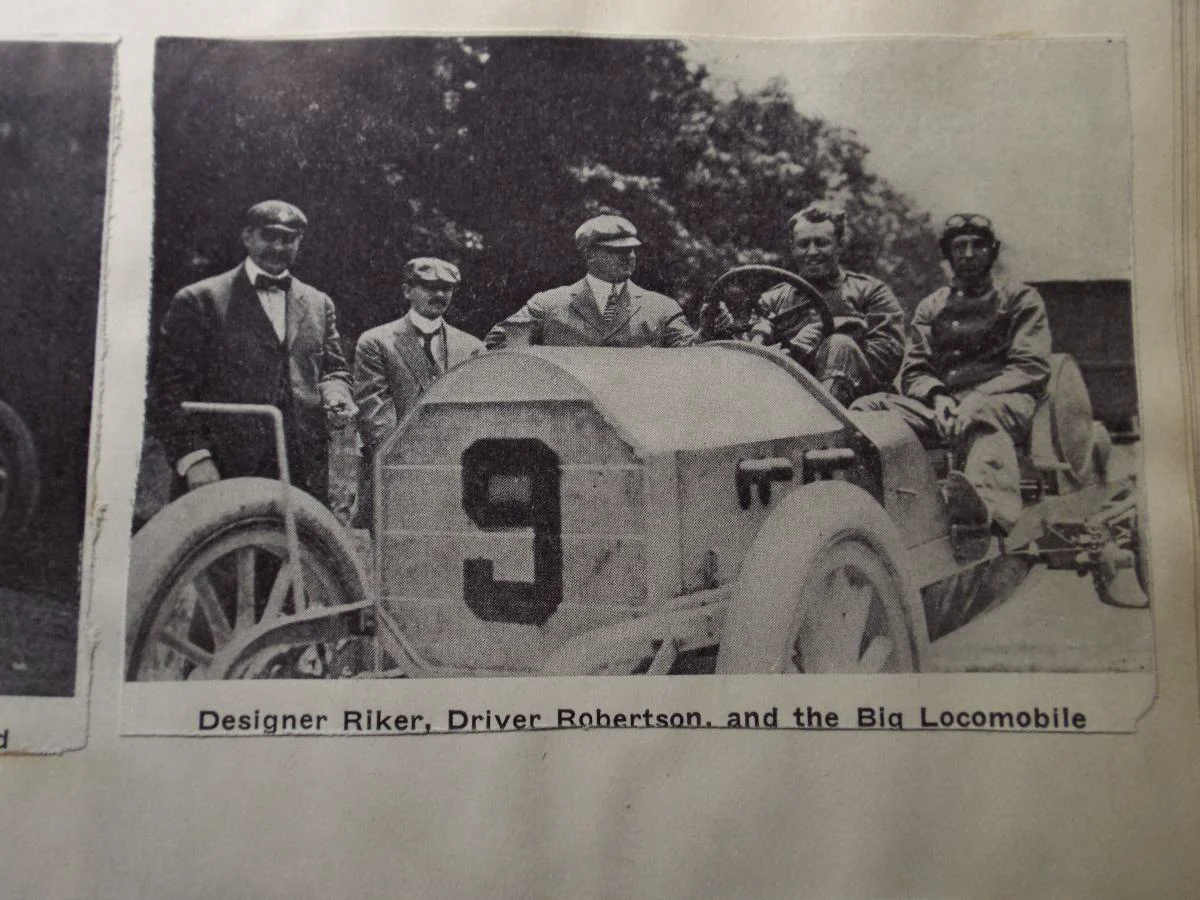
This picture leads me to believe there is some confusion and mis-information published. Sometime in late 1904 or early 1905, Locomobile made two 90 HP cars that were raced in the 1906 Vanderbuilt cup race. The two cars were plagued with blowouts so for the 1908 race they were fitted with detachable wheels and old sixteen, as it became known, won the race, with #1, the sister car, coming in second but crashing into a car on the track at the finish line. The number 1 and the number 16 were the numbers assigned to the two cars for the 1908 race. The number 1 car, in wrecked condition, was purportedly in a collection including old sixteen owned by Peter Helck. The confusion is surrounding a purported behemoth of a car built by Locomobile. In some articles it is said to be the number 1 car, the number 1 being the designation for the 1908 Vanderbilt Cup. Another picture evidently taken on race day of the number 1 car shows a car very similar to this one, but having two exhaust ports, not the four of this car. The "Big Locomobile," is evidently not one of the two 90 HP cars.
An article by Alex Dragone identifies old sixteen as a 120 HP car but old sixteen has two exhaust ports. The number 1 car and the number 16 car both have 2 exhaust ports and both are said to be 90 HP sister cars by other articles. So what car is this? If there were two 90 HP cars built with two exhaust ports each, then this car has to be "The Big 120 HP" car.
The following quote is from the Locombile society webpage,
In 1908, Riker designed a 120 H.P. 1,032 cubic inch displacement, overhead valve engine at a cost of $18,000 to compete in the prestigious Vanderbilt Cup race in Long Island, N.Y. Racing against Fiats, Isottas and Mercedes; it won and took the trophy for the Americans for the first time. The Vanderbilt Cup races were world events and Locomobile’s reputation soared. (1)
The two 90 HP cars were said to have cost $40,000.
Yes, but is old sixteen one of the 90 HP cars or is it the Big Locomobile, the 120 HP car, or am I totally confused. This car is designated #9, not 1 or 16. In the first photo there is a faint nine on the radiator so it is the same car.
AHaAug 31, 2019Yes, but is old sixteen one of the 90 HP cars or is it the Big Locomobile, the 120 HP car, or am I totally confused. This car is designated #9, not 1 or 16. In the first photo there is a faint nine on the radiator so it is the same car.
I think what you are seeing is not a #9, but there the air was sucked through the radiator to the fan blades. The #9 on the second picture is more squared off.
I believe you are correct about the number but the two cars certainly appear to be the same. Same four ports through the hood with four elongated holes in the hood. Old sixteen is a very famous car so there is no mystery here. Old 16 has two exhaust ports, while this car has four. That would indicate one port per cylinder, which would indicate a higher HP car. Old 16 has one port per two cylinders. This would make old 16 one of the 90 HP cars. This car must be the 120 HP car but there is little to no information out there and old 16 is said to be the 120 HP car.
Also, the quote above from the Locomobile society says that Riker made an over head valve, 120 HP car for the 1908 race and old 16 is overhead valve. That still leaves the question, "What car is this?" It is a four exhaust port car where old 16 has two ports.
In the video above old 16 is identified as a 90 HP car. If this is correct then it is not the 120 HP car, the "Big Locomobile," Riker made in 1908. That car is evidently the car above. What is the story of this car? The information on the web confuses the 120HP car with old 16 but the two cars are different.

The two cars in the 1908 Fairmount Park race were both model 40's. George Robertson was the winner driving #10 and Joe Florida finished in 5th place driving #9. All cars in the race were supposed to be strictly stock but there were no technical inspections by officials. Two weeks after his impressive Fairmount Park win Robertson won the Vanderbilt race in Old 16, a race car designed by the factory.
As a matter of interest, Robertson won the 1909 Fairmount Park race driving a Simplex.
So the question then is, do model 40 cars have four exhaust ports or two? We know the two 90 HP cars had two exhaust ports. The question remains: "What car is this?" Since we are relatively sure old 16 is one of the 90 HP cars, what happened to the 120 HP car? I know I'm not the first person to ask this question, so the answer is out there.
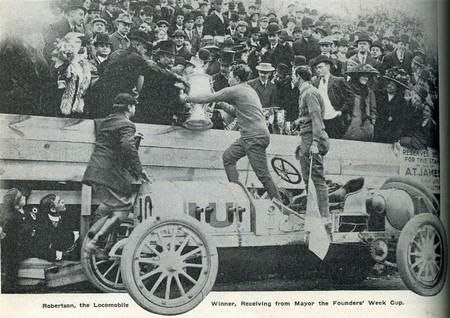
I have some clarification. Here is a picture of George Robertson accepting the trophy after winning the 1908 Fairmont race. As stated above, it is purported to be a stock model 40 Locomobile and is the spitting image of the car I posted above of Joe Florida with the same four ports coming out of the hood and the same four elongated holes in the hood. Neither of the two specially built 90 HP cars had one exhaust port per cylinder and I don't believe model 40 cars had one exhaust port per cylinder either. I would still like to know: What car is this? It was labeled, "The Big Locomobile," in the scrapbook picture above. I would also like to know what happened to the 120 HP car that Riker commissioned in 1908? The two 90 HP cars were saved through history, surely the 120Hp car was saved as well?
I found a picture of a model 40 motor on the internet and can now confirm the model 40 has four exhaust ports that would match up to the four exhaust pipes exiting the hood on the two 1908 Fairmont cars. I'm beginning to think the news report of a new race car commissioned in 1908 by Andrew Riker is a bogus report. The car above labeled, the big Locomobile, undoubtedly refers to the model 40, which was new for the 1908 model year.
Nothing to see here folks, move along, move along.
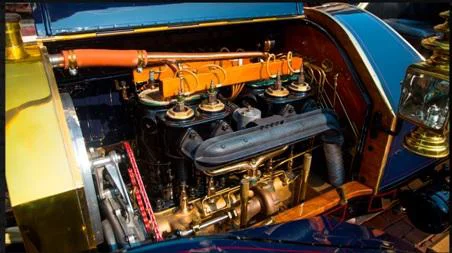
As a matter of interest, Old 16 is presently on exhibit at the Audrain Auto Museum in New Port, RI.
This is the quote from the Locomobile society that started all the confusion:
In 1908, Riker designed a 120 H.P. 1,032 cubic inch displacement, overhead valve engine at a cost of $18,000 to compete in the prestigious Vanderbilt Cup race in Long Island, N.Y. Racing against Fiats, Isottas and Mercedes; it won and took the trophy for the Americans for the first time. The Vanderbilt Cup races were world events and Locomobile’s reputation soared.
This sentence contains several pieces of information that is wrong. It was in 1904-5 that Riker designed two 90 Hp race cars at a cost of $40,000. The two cars were entered in the 1908 Vanderbilt Cup Race and #16 won the race and Locomobile's reputation soared. Unless some one can prove otherwise, there was no 120Hp car commissioned by Riker in 1908 or any other year.
I don't know where the 120 number came from. The following is from a 1948 Poplular Science Magazine. It speaks of one car built in 1905 at a cost of $18,000, the second built in 1906 is now known as old 16. This article says the two cars were almost identical.
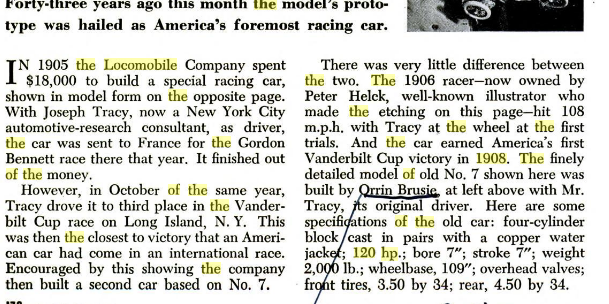
Now I'm more confused than ever. This car is labeled as the #7 car made in 1905 by Locomobile and it has four exhaust ports yet it is very different from the model 40 cars raced in the 1908 Fairmont.
From these older accounts it would now appear Riker commissioned the first race car in 1905 and it raced in the 1906 Vanderbilt Cup race. Coming in third, Riker was encouraged, and commissioned another car in 1906. Evidently the 1905 car was a T head, 7" bore x 7" stroke 90 HP car with individual exhaust ports, while the 1906 car was an F head, overhead valve, 120 HP car, 7" bore x 7" stroke with combined exhaust ports. The cars are said to be "similar" and "sister" but those terms are misleading. The two cars have four wheels each but that is where the similarities end. The search for the truth continues.
Please note that early engines with non detachable heads had PORTS above both intake and exhaust valves which were necessary in order to install/remove valves. What you keep referring to as ports are straight exhaust pipes.
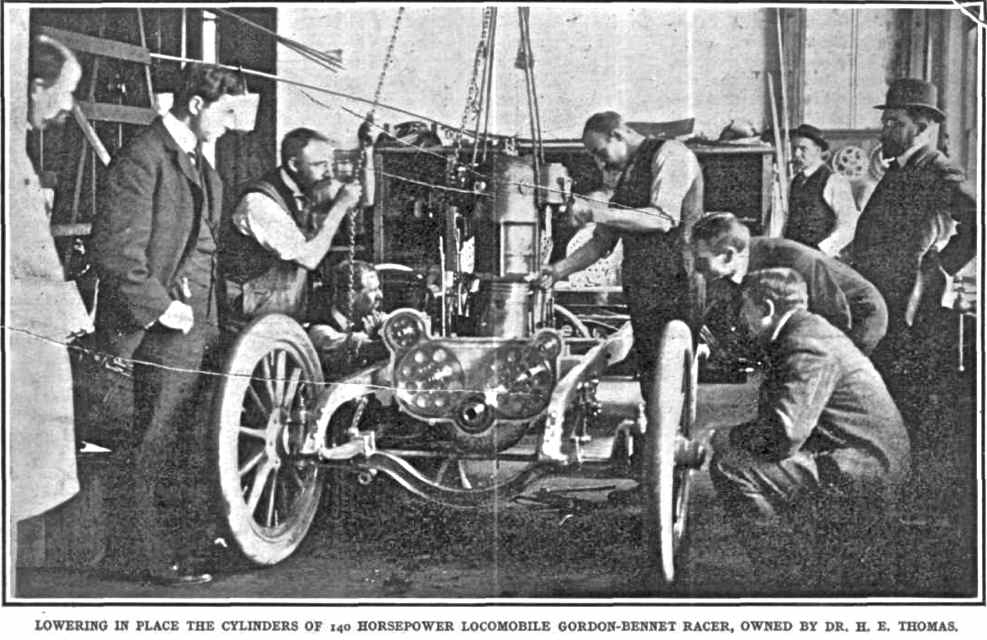
Here is another picture of the 1905 car. The 7" piston is visible as the cylinder is being lowered onto it. This confirms the 1905 car was the 120 HP car. There was only one car commissioned in 05, not the two sister cars reported elsewhere. That should make old 16 a 90 HP car. This would indicate a smaller bore and stroke than the 05 car and the overhead intake valves would increase HP. Can anybody here tell me the bore and stroke of old 16? A measurement of the cylinder wall minus 1/2" would indicate bore size. I suspect it is closer to 6". A close estimate is better than what I have now. Anybody planning on visiting the Audrain Auto Museum in RI?
I would still like to know if this motor was later placed in one of the 08 Fairmont race cars, and could it possibly be the one which won the Fairmont race? If so it would most likely be in the car above labeled the Big Locomobile and surely the second car in the 08 Vanderbilt Cup Race and the reason no one knows where it is today and the reason there is so much confusion over the two cars.
The July 20, 1905 edition of The Automobile contains an in depth article on the 05 Gordon Bennett Race. The Locomobile is said to be a 4 cylinder, 3 speed car, of 176 x 176 MM bore and stroke (7"x7") and 120 HP and wheelbase of 2.85 meters (111") in this 1905 article and the car was weighed in at 1.007 Kilos. The two pictures directly above are from that article. This confirms the 1905 car to be the 120 HP car. It was actually commissioned and paid for by Dr. H. E. Thomas at a reported cost of $18,000 but manufactured by the Locomobile company. To date I have found no specifications on the 1906 car, though I'm sure they are out there to be found. The amount of misinformation concerning Locomobile and the years between 05 and 08 and the race cars going back to the earliest days is astounding as exemplified by this thread and my attempt to discern the truth.
This article makes it plain that Locomobile engineers built the car but it was Dr. Thomas that requested it and at a cost of $18,000, the car belonged to Dr. Thomas. This was not Locomobile going racing, it was Dr. Thomas going racing. It was Dr. Thomas that hired Tracy on a wink and a nod to drive the car.
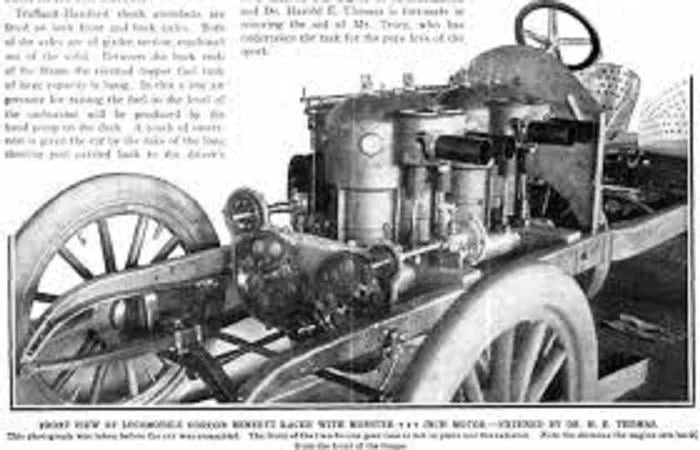
I may have detangled this web a bit further. It appears now that Locomobile did produce two race cars in 1905 at a cost of $40,000. These cars are true sister cars, being exact duplicates. Old 16 is one of these two cars. They were both reported to be 90 HP cars. The problem from the beginning is that the 120 Hp car commissioned by Dr. Thomas is routinely confused with the two cars commissioned by Locomobile's chief Engineer, Andrew Riker. Then in 1908, Locomobile took two stock model 40 chassis and converted them into race configuration and entered them into the 1908 Fairmont race. As I stated above, the 120 Hp car was never Locomobile's car. It was commissioned by Dr Thomas and the costs of building it was paid by Dr Thomas, but it was built in the Locomobile factory by Locomobile engineers. Thus it was branded a Locomobile. This is where the confusion begins.
In the May 1905 edition of The Automobile, it is reported that Locomoblie did a test run of Dr. Thomas' car and made arrangements for the car to be shipped to France for the Gordon Bennett race without Dr Thomas' knowledge. Evidently Dr Thomas did not cotton to Locomobile taking over possession of his car and he ordered it withdrawn from competition. The car had already garnered quite a bit of excitement however because it performed very well and there was evidently quite a bit of pent up desire to beat the Europeans in a race. The driver, Joe Tracy, said the car would do a 30 second mile. The American racing association threatened to ban the car from competition because Dr Thomas would not allow the car to compete.
It is interesting to note that Dr Thomas shopped around for a company to build him a race car. When he contacted Locomobile in the fall of 04, the company thought if they priced the car high they could convince Mr Thomas to look elsewhere. They gave him a price of $18,000 and he wired them a check for $6,000 the next day.
This information is from "The Auto Racing Comes Of Age" book, first published in 2013.
It turns out Dr Thomas was from New York but lived in Chicago. It was Dr Thomas' Locomobile that was entered into the 05 Vanderbilt and finished third. In the May 05 edition of the Automobile, the Thomas Locomobile is assigned 60, 90 and 120 HP. On September 22 of 06, Tracy and the Thomas Locomobile won the Vanderbilt elimination.
The Locomobile that won the 08 Vanderbilt race with George Robertson at the wheel was old 16. The bore and stroke of old 16 is 7.25 x 6. According to this book, old 16 was offered for sale in the 07 and 08 Locomobile sales catalog as the "Cup Racer, 90 HP for $15,000" but it is more likely the Thomas car that was offered for sale. You can see how this gets confusing.
Here is a picture of the Harold Thomas car built in the Locomobile factory by Locomobile engineers at a cost of $18,000 on the Vanderbilt cup race course during trials. Joe Tracy is at the wheel. It is reported that Locomobile was reluctant to get into racing, so when Dr. Harold E. Thomas of Chicago, approached the company in August of 04 about building him a race car, they sought to price Dr. Thomas out of the market by giving him a quote thought to be beyond his means. The terms were 1/3rd up front, 1/3rd half way through, and 1/3rd upon completion. These negotiations were done by wire service. The company was disappointed when a check for $6,000 arrived the next day. The car, designed by Andrew Riker, had a 7" bore, 7" stroke, T head motor, with individual exhaust ports in each cylinder and cast in place water jackets. As the car was finished it generated a lot of excitement both in the factory and the larger racing community and Locomobile let their excitement overshadow their prudence in making arrangements to race the car without Dr. Thomas' input. Dr Thomas was having none of that and ordered all of Locomobile's efforts canceled, and reasserted his rights over the car. This undoubtedly prompted the creation of the two 7.25" bore x 6" stroke race cars commissioned by Andrew Riker, chief engineer at Locomobile. Locomobile never intended to race two cars though, the second car was made as a backup to the first, along with enough spare parts to build two more cars. The locomobile cars had overhead intake valves and copper water jackets and combined exhaust ports per 2 cylinders, for a total cost of $40,000. Obviously the horse power of the Thomas car at 7x7 and the Riker cars at 7.25x6 would be too similar to be distinguished.
The cars come to be identified by the numbers assigned to them in the most notable race of the car's history. Thus the Thomas car is known as old #7 and the two Locomobile cars are known as old #1 and Old #16. Andrew Riker was a prudent man though and realized he could neither justify or recoup the cost of these race cars so in 1908, he reconfigured two stock model 40s for the Fairmont park race.
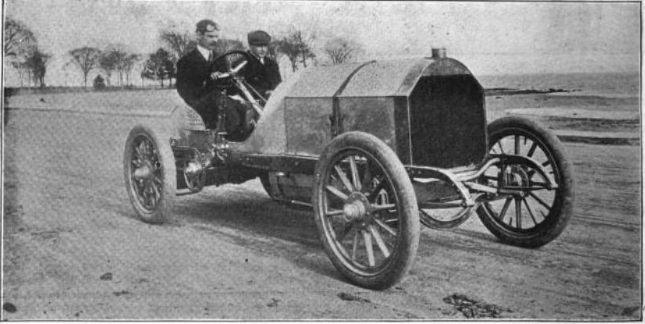
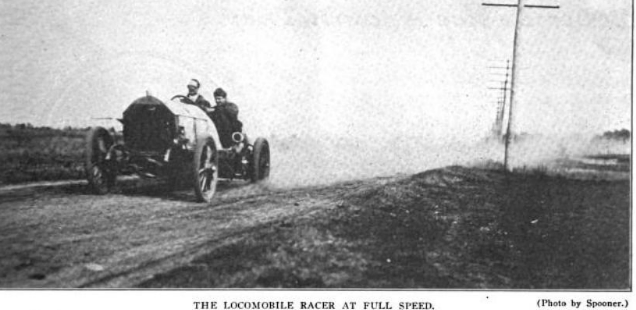
Another picture of the Thomas car. Since the Thomas car was designed and built by Locomobile, it was thought of as a Locomobile car, which in fact it was, but commissioned by an individual at considerable costs. Hence the confusion. I wonder if such an arrangement was entered into by any other car companies. Dr Thomas had two brothers who also went racing. Dr. Thomas had been racing a Locomobile around Chicago with fantastic results and this prompted him to order a limousine from the factory and inquire about the company building the race car. It is quite comical in hindsight as Locomobile asserted with the announcement they would be building the Thomas race car, that the Locomobile company would not now or ever get into racing and whatever people did with their cars would be on their own. Not long after this there were building the two Locomobile race cars.
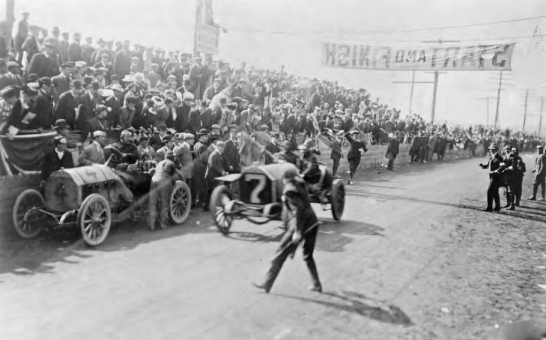
Joe Tracy finishing third in the second Vanderbilt Cup Race, October of 1905 with the Thomas car.
To join in the conversation, you must be a club member.
You’re welcome to read and like every post. Members can reply and start topics of their own.